BEE REMOVAL
Bee Removal in Central Florida
Bees going in and out of a wall, soffit or shed? Keep people and pets back, leave the opening alone, and call.
- Walls, soffits and sheds
- Don't seal the hole
- Same-Day Service
- Free Inspection
- 4.7 Google Rating
- Same-Day Service
- Free Inspection
- Sealed for Good
What should I do about bees in my wall in Florida?

Don't spray them and don't seal the hole: blocking it drives the bees deeper into the house. In Florida, a colony should be removed alive by a registered beekeeper or eradicated by a licensed pest control operator, and the comb taken out. Keep people and pets away and call (844) 264-6254.
- Don't seal the hole
- Don't spray
- Comb must come out
- Swarms move on
Which bee is it?
The bees you're likely to find at home
Not every bee around the house is a problem, and each kind nests differently. Look from a safe distance before you do anything.
Honey bees
Live in large colonies inside cavities: walls, soffits, sheds, water meters. In Central Florida these can be European, African or a mix, and a colony in a structure needs a professional.
Carpenter bees
Look like bumble bees but have a shiny, greenish-black abdomen. UF/IFAS says they drill clean, half-inch holes into trim, railings and siding and tunnel 3 to 6 inches into the wood.
Bumble bees
Fuzzy all over. UF/IFAS says Florida's five species nest at or below ground, often in old rodent burrows, dense grass or crevices by a foundation, and the colony dies off by early winter.
Signs
Swarm or colony? How to tell
UF/IFAS draws a clear line between the two, and it changes what needs to happen.
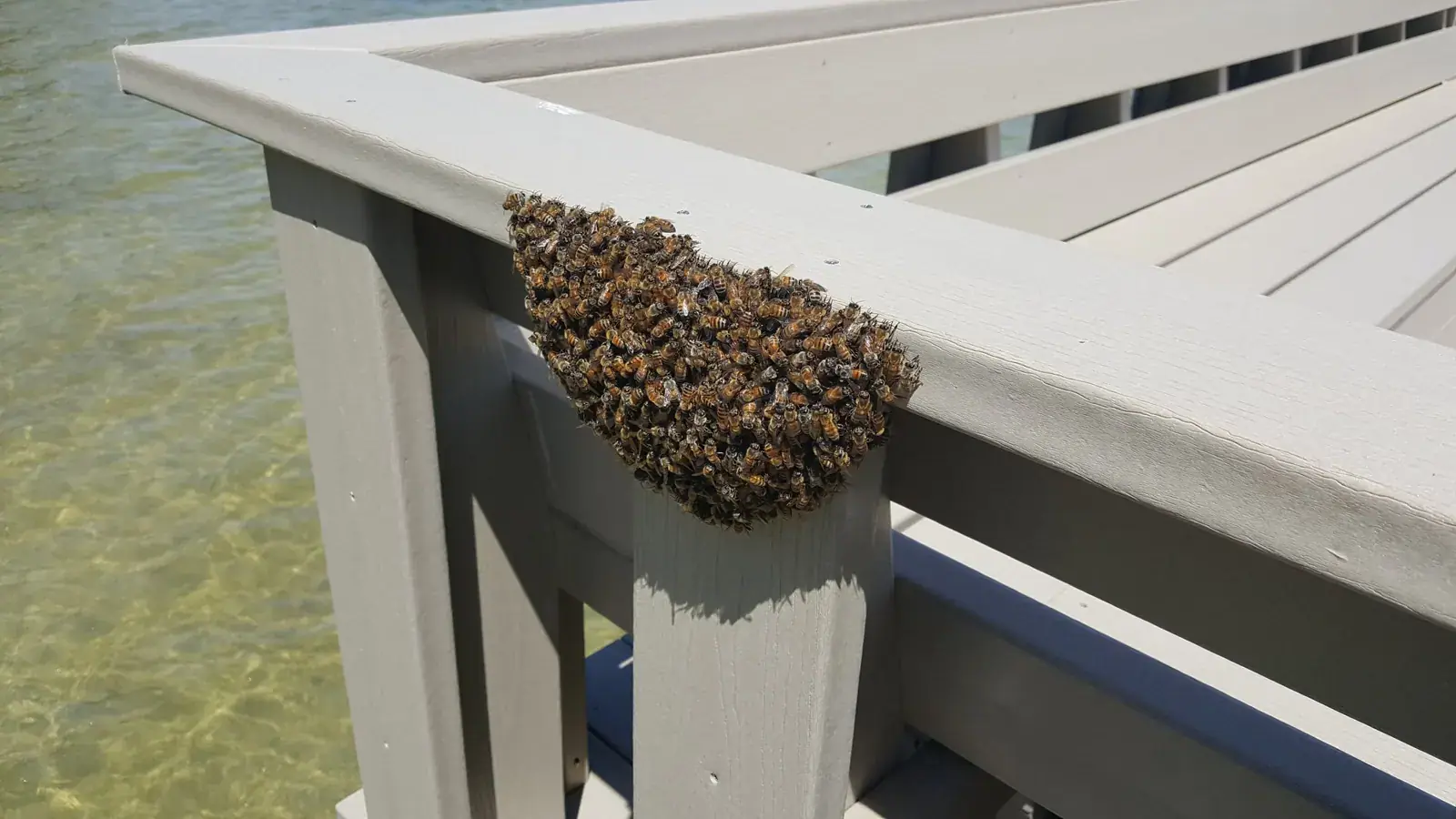
A swarm: a ball of bees in the open
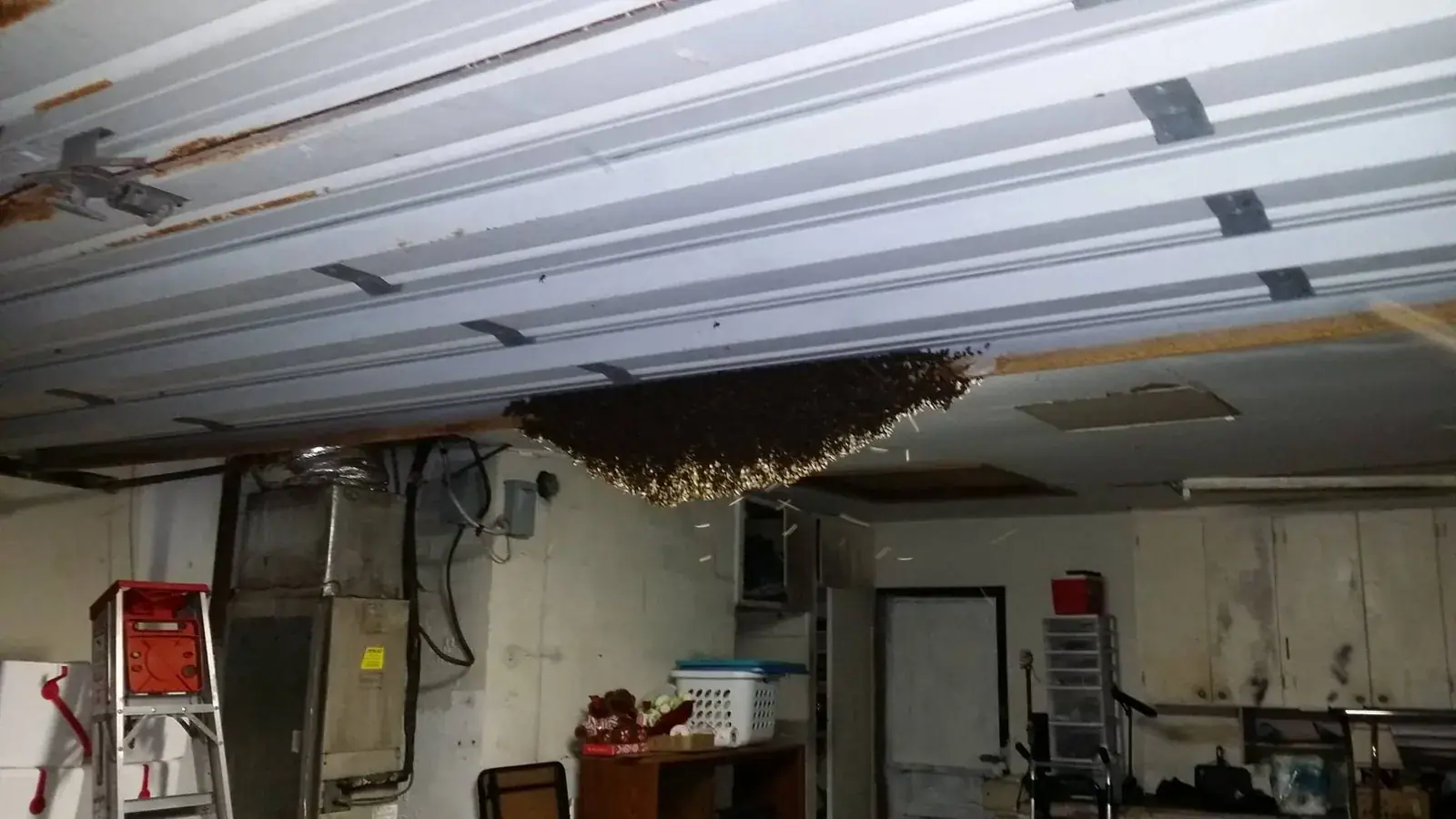
A cluster hanging on a branch, fence or eave. UF/IFAS says swarms are temporary, staying a few hours to a few days, and are usually calm because they have no nest to defend.
A colony: bees flying in and out of a hole
A steady line of bees going into a gap in a wall, soffit, roof edge or shed. That means comb, honey and young inside, and bees that will defend them.
Humming in a wall
A buzz you can hear through drywall, or a warm spot on an inside wall, can mean comb behind it.
Stains or honey seeping
Dark stains or sticky honey on a wall or ceiling. UF/IFAS notes comb left in a wall can melt into the structure and stain it.
Bees in odd places
UF/IFAS lists water meters, gutter downspouts, pipes, holes in siding, cinderblocks, under sheds and under playground equipment as common nest sites.
Comb in a cluster
If a cluster in the open is building wax comb, UF/IFAS warns it's the start of a colony, not a passing swarm.
Why it matters
Why Florida bee colonies need care
Honey bees matter, and a swarm passing through is usually better left alone. A colony living in your house or next to where people walk is different, especially in Central Florida.
- African honey bees are here. UF/IFAS says African bees were first documented in Florida in 2001 near the Port of Tampa and have spread through the southern half of the state, mixing with European honey bees.
- They defend hard. UF/IFAS says an African colony may send out hundreds or thousands of bees in response to a disturbance and chase an intruder 400 yards or more.
- Sealing the hole backfires. UF/IFAS warns that closing an active opening forces bees further into the wall and possibly into the living space.
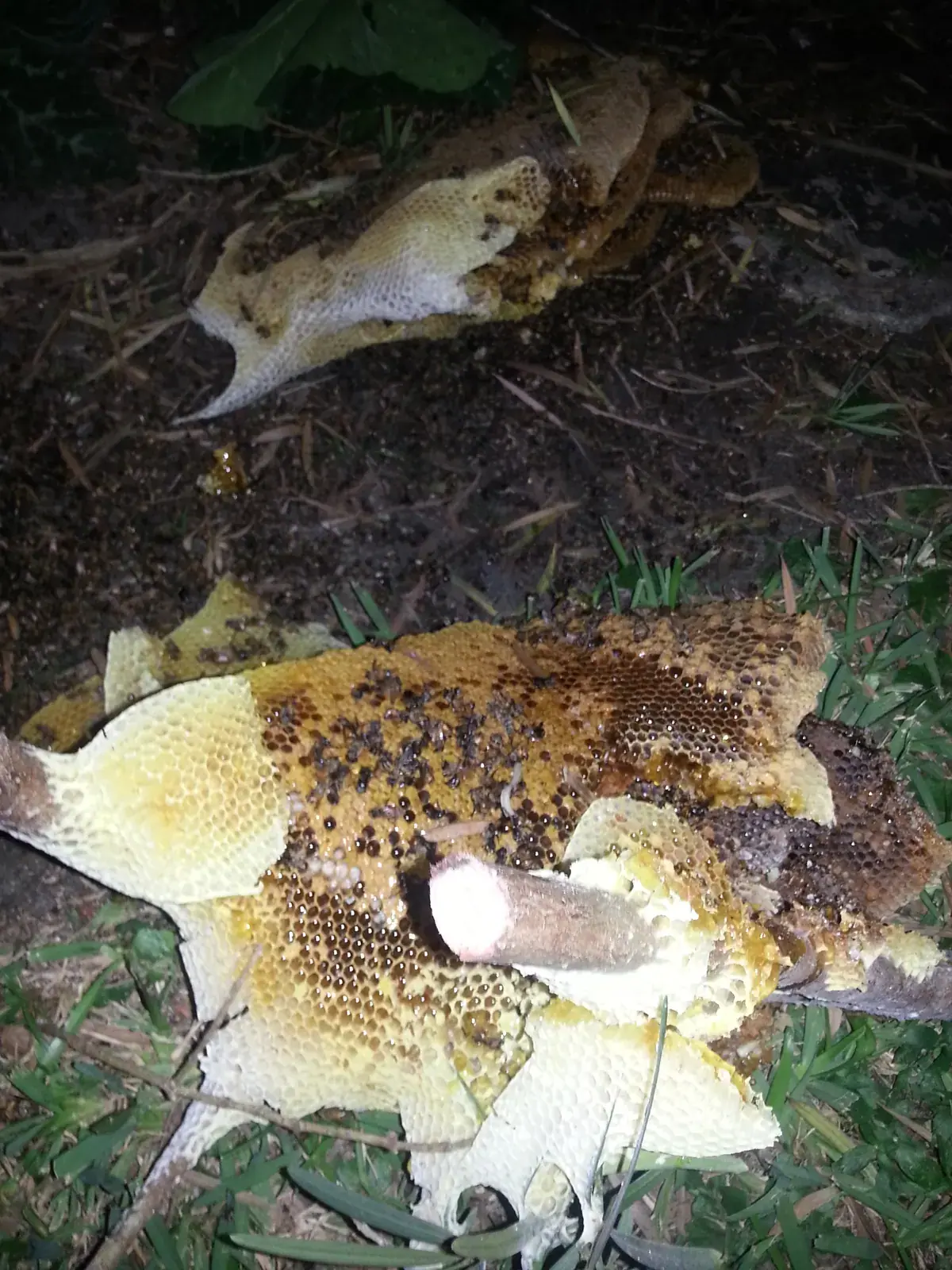
- Comb left behind causes damage. Honey, wax and dead brood left in a wall can melt, stain, smell and draw wax moths, beetles and other pests, according to UF/IFAS.
Found a nest?
What to do when you find bees
- 1
Back away
Move people and pets away from the area. UF/IFAS says untrained people should never disturb a colony.
- 2
Watch from a distance
Note where the bees go in and out, and whether it's a loose cluster in the open or a steady stream into a hole.
- 3
Don't spray or plug it
Spraying or blocking the entrance can push the colony deeper into the wall. Leave the opening alone.
- 4
Call for removal
Tell us where the bees are, how high, and whether anyone has been stung.
How bee jobs work
From the first call to a sealed wall
- 1
Look and listen
We find where the bees go in, whether it's a swarm or a colony, and where the comb sits. In a wall, that can mean feeling for warmth and listening for the hum, as UF/IFAS describes.
- 2
Agree the plan with you
How the colony will be removed, how the wall or soffit will be opened, and who arranges the repair afterward, all settled before work starts.
- 3
The colony and the comb
UF/IFAS says a job isn't finished until the entire nest is out: bees, comb, honey and brood. Leaving it in the wall invites the next problem.
- 4
Bee-proof the gap
Once the cavity is empty, UF/IFAS advises sealing the opening so a new swarm can't move into the same space.
Florida rules
Who can remove bees in Florida
- Live removal by a registered beekeeper. A beekeeper registered with the Florida Department of Agriculture and Consumer Services (FDACS) may remove and relocate bees alive without a pest control license (Rule 5E-14.151, F.A.C.). UF/IFAS lists a registered beekeeper or a trained pest control operator for live removal.
- Everything else is pest control. Anyone else removing bees, and anyone killing them, is doing pest control, which needs a licensed pest control company (Chapter 482, Florida Statutes).
- The property owner is responsible. UF/IFAS says dealing with an unwanted swarm or colony is up to the owner of the property.
- Neither is required to kill or save. There's no Florida law that forces either a live removal or an eradication. Colonies that are defensive, near people or animals, or have stung someone may be better eradicated, UF/IFAS says.
The Florida Department of Agriculture keeps a county-by-county Bee Removal or Eradication List. Read UF/IFAS's Living with the African Honey Bee and Nesting Bees and What You Should Do.
Bee-proofing
Keeping the next swarm out
UF/IFAS says Florida's swarm season runs from March to July, when swarms are out looking for a cavity with a small opening. These are the fixes it recommends.
- Gaps of 1/8 inch or more caulked with 100% silicone
- Vents, drains, downspouts and plumbing covered with 1/8-inch hardware cloth or insect screen
- Water meter covers and holes in siding closed
- Old comb removed so it can't melt or draw pests
- A weekly look around the house from March to July
- Repairs to the wall or soffit are arranged by the owner with a contractor
Cost
What bee removal costs depends on
Swarm or colony
A swarm in a tree is a short job. A colony in a wall means finding and removing comb.
Where the comb is
A shed or meter box, or high in a soffit or deep inside a wall.
Opening the wall
Cutting into drywall, soffit or siding to reach the comb. The owner's contractor closes it again.
Size of the colony
An established colony can fill a wall cavity with comb.
Areas served
Bee removal in 8 counties
African honey bees were first documented in Florida in 2001 near the Port of Tampa. We take bee calls across the bay area and the counties around it.
- Pinellas County
- Clearwater
- Dunedin
- Tarpon Springs
- Hillsborough County
- Brandon
- Plant City
- Lutz
- Carrollwood
- Town 'n' Country
- New Tampa
- Keystone
- Greater Northdale
- New Port Richey
- Land O' Lakes
- Dade City
- Hernando County
- Spring Hill
- Citrus County
- Crystal River
- Lecanto
- Sumter County
- Bushnell
- Ocala
- Dunnellon
- Summerfield
- Lakeland
- Bartow
- St. Petersburg
- Palm Harbor
- Largo
- Pinellas Park
- Tampa
- Riverview
- Odessa
- Westchase
- Citrus Park
- Temple Terrace
- Cheval
- Lake Magdalene
- Pasco County
- Trinity
- Hudson
- Wesley Chapel
- Brooksville
- Weeki Wachee
- Inverness
- Homosassa
- Pine Ridge
- Wildwood
- Marion County
- Belleview
- Silver Springs
- Polk County
- Winter Haven
- Haines City
Reviews
What customers say
- ★★★★★
Josh came out & removed a dead cat from my engine that had been there for over six months! Absolutely no one else would do the job and other places said they couldn’t even find the animal. Josh found it and removed it with ease. I can’t thank him enough!
Allyson Hill
- ★★★★★
I had issues with squirrels secreting themselves under my tile roof. Josh and his associates competently/professionally sealed off all ingress locations thus preventing any squirrel inhabitation. Tangentially, they returned on numerous occasions at my behest to reassure me that although I may see squirrels on my roof they were not entering any crevices and/or secreting themselves under my tile roof. On each return occasion the associate re-examined all locations that had been closed. On every return the associate was professional in nature and interfaced with me in a convivial manner. I am appreciative of their commitment to mission and would highly recommend them.
Larry A.
- ★★★★★
Brandon came out of his way to help remove a raccoon who had decided to use my front door mat for nap. Brandon was very polite and professional. He removed Ralph without issue and pretty quickly.
Cassandra Bronzo
FAQ
Bee removal questions
There's a swarm of bees on my tree. Will it leave?
Often, yes. UF/IFAS says swarms are temporary and stay a few hours to a few days, and they're usually calm. Keep people and pets away and don't disturb it. If it starts building comb or is still there after a few days, it's becoming a colony: call us.
Can I spray the bees myself?
UF/IFAS says untrained people should never disturb a colony. Killing a colony counts as pest control in Florida and has to be done by a licensed pest control operator. Leave it to a professional.
Can I just seal the hole the bees use?
No. UF/IFAS warns that sealing an active opening forces the bees further into the wall and possibly into your home. The colony and comb have to come out first.
What do I do if bees attack?
UF/IFAS says run in a straight line to shelter, cover your face as you go, and get inside a house, shed or car. Don't jump into water, don't hide in bushes and don't swat. Call 911 if someone is being attacked. Pull stingers out as fast as you can: the method doesn't matter.
Are the bees at my house African honey bees?
Assume they could be. UF/IFAS says African bees have been in Florida since 2001 and hybridize with European honey bees, and the hybrids show an unpredictable mix of both kinds of behavior. Treat any colony in Central Florida with care.
Do you remove bees in Pasco and Hillsborough County?
Yes. We take bee swarm and beehive calls across Pasco and Hillsborough counties and the six other Central Florida counties we serve. Call (844) 264-6254.
Why does the honeycomb have to come out?
UF/IFAS says comb left in a wall can melt and stain it, the honey ferments and the brood rots, and wax moths and beetles move in. Removing the whole nest is part of the job.
Read more
Related guides
Bees in a wall or soffit?
Keep everyone back and call (844) 264-6254.
Serving Central Florida: Pasco, Pinellas, Hillsborough, Hernando, Citrus, Sumter, Polk and Marion counties.