RACCOON REMOVAL
Raccoon Removal in Central Florida
Thumping in the attic or a torn soffit? We get the raccoons out, babies included, and seal the way in.
- Babies checked for first
- Entry sealed
- Same-Day Service
- Free Inspection
- 4.7 Google Rating
- Same-Day Service
- Free Inspection
- Sealed for Good
How do you get a raccoon out of the attic in Florida?
Find out whether there are babies, remove the raccoons by live trap, one-way door or by hand, keeping mother and young together, then seal the entry. In spring, assume a mother with kits. A trapped raccoon may only be released on site or on 40+ contiguous acres in the same county with written permission. Call (844) 264-6254.
- Check for babies
- Births March to April
- Strict release rules
- Entry sealed
Signs
Signs you have raccoons
Raccoons are big, strong and not subtle. If one is living in your house, you'll usually know. More on raccoons in the attic.
Heavy thumping overhead
Raccoons are far heavier than rats, and it shows: slow, heavy steps and thumps rather than a light scurry. In spring, listen for the calls of kits too.
A torn soffit or roof vent
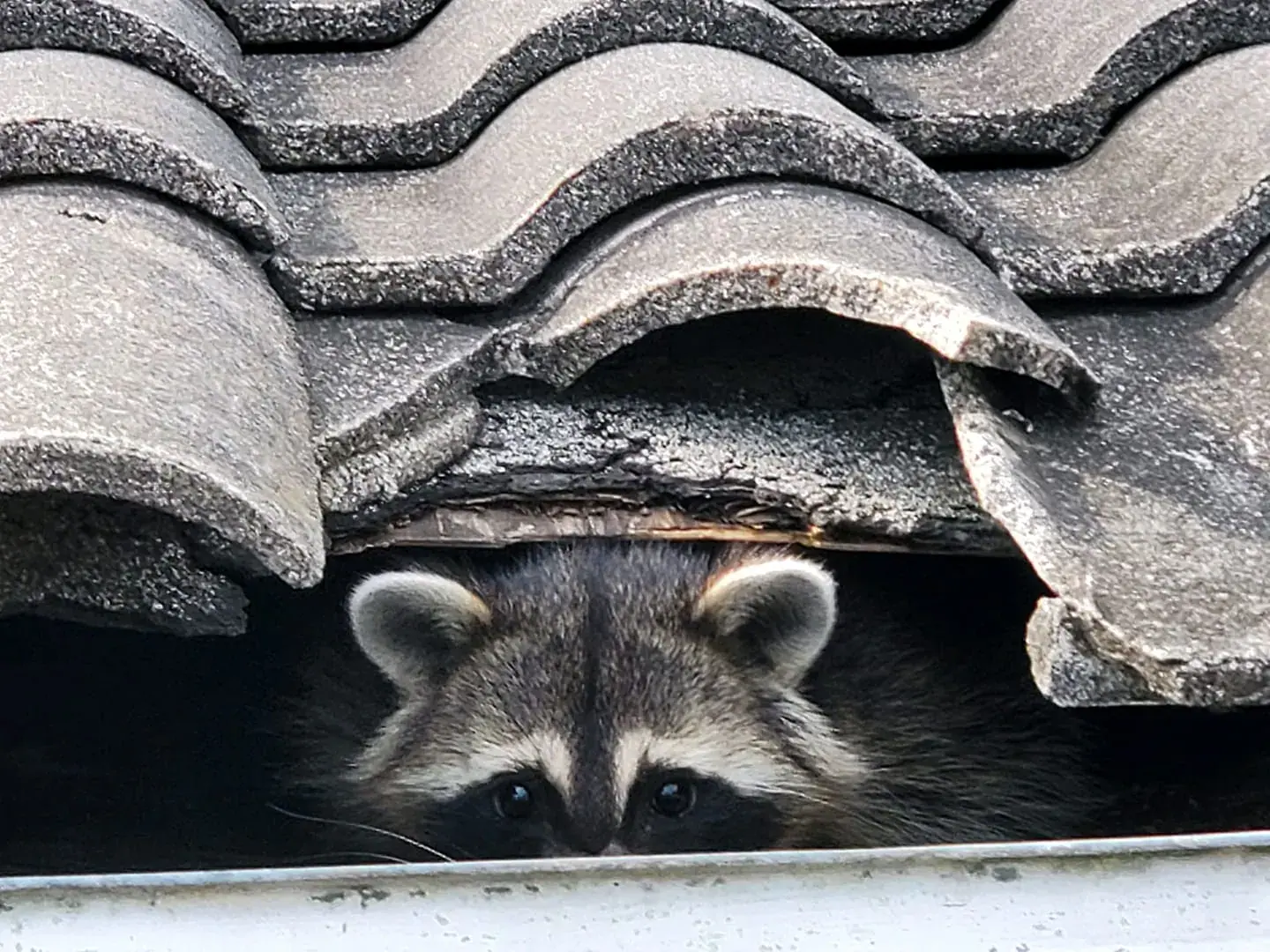
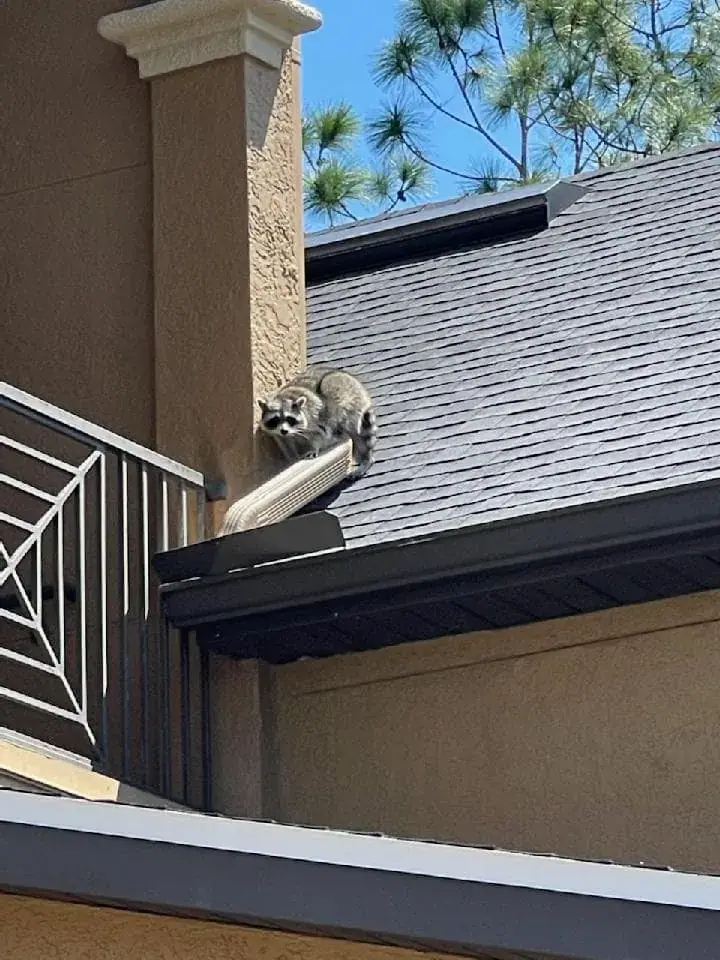
UF/IFAS says raccoons get into attics where an entry point isn't maintained or repaired. A rotted or loose soffit, a damaged roof vent or a gap at the roof edge with bent or torn material around it is a strong clue.
Something living in the chimney
UF/IFAS lists open chimneys among the common ways raccoons get into a house. Scratching and calling from the fireplace in spring often means a den with young.
A pile of droppings in one spot
Raccoons share toilet spots called latrines. FWC says in suburbs they turn up under trees, in sandboxes and on decks and patios. Droppings piled together in one place point to raccoons.
Raided trash and pet food
Knocked-over garbage cans and empty pet bowls in the morning mean raccoons are feeding nearby, and a den is often close.
Under the house or deck
UF/IFAS notes raccoons also move in under mobile homes and decks. Look for gaps in the skirting and lattice.
Why it matters
Why raccoons in the house need to go
Raccoons aren't out to hurt anyone, but an attic den brings real problems.
- Rabies. Along with bats, raccoons are one of the two main wildlife carriers of rabies in Florida, according to the state Department of Health. UF/IFAS puts the share of wild raccoons exposed to rabies at fewer than 1 in 200: low, but not a risk to ignore. Never corner or handle one.
- Raccoon roundworm. The CDC says people can be infected by swallowing the parasite's eggs from raccoon droppings, usually by accident, and that most cases are in children. FWC says the roundworm appears widespread in Florida but at low levels. Infections are rare and can be severe.
- Damage. Torn soffits, vents and roof edges, crushed and soiled insulation, and rain getting in through the hole they made.
How we remove raccoons
Our raccoon removal process
Most raccoons in Florida are born in March and April, according to UF/IFAS. From late winter into summer, the first question on any raccoon job is: are there babies?
- 1
Inspect and look for kits
We find the entry hole, any other weak spots, and the den. If there are young, we locate them before anything else happens. Wildlife agencies warn against sealing an entry while young are inside, because they'd be cut off from their mother.
- 2
Remove the family together
Depending on the house and the season, the adult is caught in a live trap checked at least every 24 hours, or leaves through a one-way door. Kits are taken out by hand so mother and young stay together.
- 3
Follow the release rules
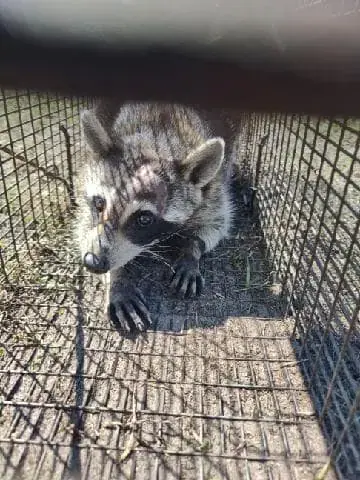
Florida allows three outcomes for a trapped raccoon: release on the property where it was caught, release on at least 40 contiguous acres in the same county with the landowner's written permission, or humane euthanasia. FWC's roundworm guidance also says not to relocate raccoons.
- 4
Seal the way in
The entry hole is sealed with materials a raccoon can't pull apart, and other weak spots are closed. We show you any latrine or soiled insulation we found.
Florida rules
Florida's raccoon rules, in plain words
- A trap can't sit for days. Florida requires every trap to be inspected at least once every 24 hours, and an animal caught alive has to be released legally or humanely put down within 24 hours of capture or inspection.
- Three legal outcomes, and only three. Under Florida's nuisance wildlife rule (68A-9.010), a trapped raccoon may be released on the same property, released on at least 40 contiguous acres in the same county with the landowner's written permission, or humanely put down.
- No park drop-offs. Letting a raccoon go in a park, or on any land without the owner's written permission, is illegal. FWC's roundworm page goes further and says not to relocate raccoons at all.
- New FWC trapping rules start December 31, 2026. They change trap check times, allow remote (camera) checks, and require most people who trap to complete FWC's annual registration and training, which FWC says is at no cost. A homeowner using one regular-size cage trap (door up to 20 by 28 inches) on their own property, to catch nuisance or non-native wildlife, doesn't need registration, training or reporting. Nuisance animals moved off site must be released or put down within 12 hours of the trap check, down from 24. Details at MyFWC.com/TrappingRules.
- Don't feed them. Florida rule 68A-4.001 bans putting out food or garbage in a way that attracts raccoons and creates, or is likely to create, a public nuisance. Pet food left out at night draws raccoons in.
FWC's nuisance wildlife FAQs cover the trapping rules in full. For the season, read raccoon mating season in Florida.
Sealing
Closing what the raccoons opened
Purdue Extension notes a raccoon will likely try to get back into a den it knows. The hole it made, and the soft spots next to it, have to be closed with material it can't tear open. If the soffit or vent itself is broken, the owner arranges that repair with a contractor. Raccoons also leave droppings where they den, and the CDC advises removing raccoon droppings promptly, before the roundworm eggs in them become infectious.
- Entry hole sealed and reinforced
- Other weak soffits, vents and roof edges closed
- Chimney capped where raccoons used it
- Latrine, nesting and soiled insulation pointed out in the inspection
Cost
What raccoon removal costs depends on
We quote after seeing the house. A raccoon under a deck is a smaller job than a mother and four kits in a second-story attic. For damage the owner may need a contractor to repair, see raccoon roof damage and cleanup costs.
How many raccoons, and whether there are kits
Kits mean finding and removing them by hand.
Where they are
An attic, a chimney, a wall, a crawl space or under a deck.
Sealing the entry
How many openings need closing, and how big they are.
Den size
A small den under a deck, or an attic the family has used for months.
Inspecting for a raccoon costs nothing. You get the price for your home before we start.
Areas served
Raccoon removal across Central Florida
Tampa, St. Petersburg, Clearwater and every town on the list below, in 8 counties. One number covers them all: (844) 264-6254.
- Pinellas County
- Clearwater
- Dunedin
- Tarpon Springs
- Hillsborough County
- Brandon
- Plant City
- Lutz
- Carrollwood
- Town 'n' Country
- New Tampa
- Keystone
- Greater Northdale
- New Port Richey
- Land O' Lakes
- Dade City
- Hernando County
- Spring Hill
- Citrus County
- Crystal River
- Lecanto
- Sumter County
- Bushnell
- Ocala
- Dunnellon
- Summerfield
- Lakeland
- Bartow
- St. Petersburg
- Palm Harbor
- Largo
- Pinellas Park
- Tampa
- Riverview
- Odessa
- Westchase
- Citrus Park
- Temple Terrace
- Cheval
- Lake Magdalene
- Pasco County
- Trinity
- Hudson
- Wesley Chapel
- Brooksville
- Weeki Wachee
- Inverness
- Homosassa
- Pine Ridge
- Wildwood
- Marion County
- Belleview
- Silver Springs
- Polk County
- Winter Haven
- Haines City
Reviews
What customers say
- ★★★★★
Brandon came out of his way to help remove a raccoon who had decided to use my front door mat for nap. Brandon was very polite and professional. He removed Ralph without issue and pretty quickly.
Cassandra Bronzo
- ★★★★★
There's a first time for everything! Somehow a snake made it's way into our office building and chose my office to hang out. I called Pro Wildlife on Sunday and explained it to the tech. They arranged the appointment to come and remove it for today @ 9am. The tech Zak Brooks arrived and got the snake out very quickly! He was friendly and professional!! Definitely recommend and we'd use them again if needed! Thank you again!
April Daves
- ★★★★★
Josh came out & removed a dead cat from my engine that had been there for over six months! Absolutely no one else would do the job and other places said they couldn’t even find the animal. Josh found it and removed it with ease. I can’t thank him enough!
Allyson Hill
FAQ
Raccoon removal questions
Do I need a raccoon exterminator?
No. A raccoon in the attic is a wildlife job, not an exterminator's. It's removed under FWC's rules, babies included, and the hole it used is sealed. That's the work we do, with no spraying involved.
When do raccoons have babies in Florida?
UF/IFAS says births in Florida generally happen in March and April, with an average litter of 3 to 4 young and as many as 7. That's why spring is the busiest time for raccoons in attics.
Can I trap the raccoon and take it somewhere else?
Not just anywhere. Florida allows release on the property where it was caught, or on at least 40 contiguous acres in the same county with the landowner's written permission. Releasing it anywhere else, like a park, is illegal, and a set trap has to be checked at least once every 24 hours.
Why not just close the hole while the raccoon is out at night?
If there are kits inside, they're cut off from their mother. Even without kits, Purdue Extension notes a raccoon will likely try to get back into an attic it treats as its den, and you have to be absolutely sure it's out before you close anything. Check first.
Are raccoons dangerous?
They usually avoid people, but they're wild animals that bite and scratch when cornered. Raccoons are one of the main wildlife sources of rabies in Florida, and their droppings can carry roundworm. Keep pets and children away and let us handle it.
How do I clean up raccoon droppings in my yard?
FWC and the CDC both advise wearing gloves, removing the droppings promptly and burning or burying them, or bagging them for the landfill. The CDC suggests boiling water or a propane flame-gun on decks and patios. Wash your hands afterwards. For an attic latrine, call us.
How do I keep raccoons from coming back?
Close the entry with strong materials, cap the chimney, trim branches back from the roof, and don't leave pet food or unsecured trash out at night. Florida law prohibits placing food in a way that attracts raccoons. See what to do about raccoons.
Can you come out at night for a raccoon in the house?
Same-day visits are often available for a raccoon loose in the house. If it's inside the living space, tell us when you call.
Read more
Raccoon guides
 Raccoons
October 26, 2026
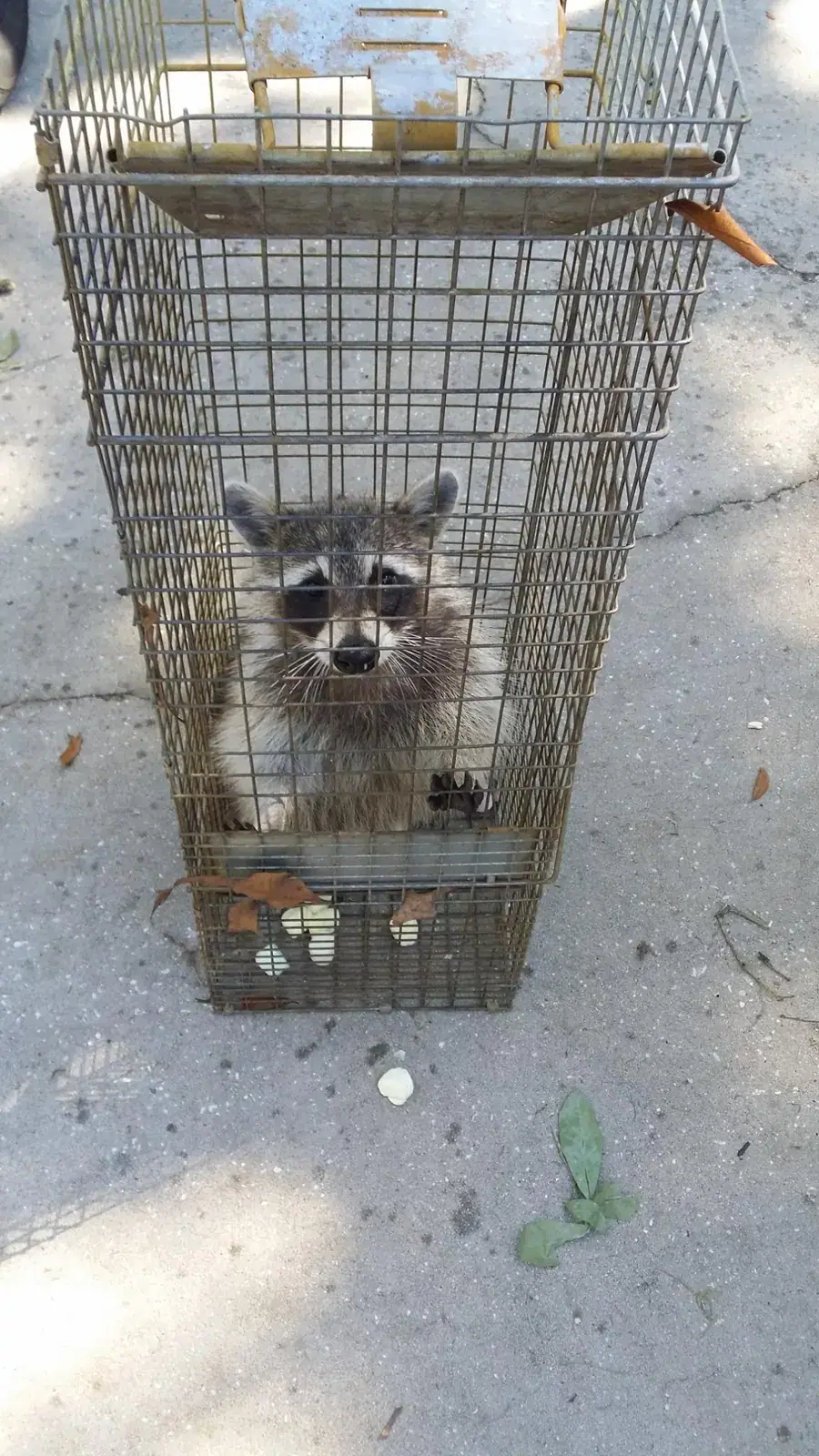
Raccoon Trapping in Florida: Traps, Bait and the Rules
You can live-trap a nuisance raccoon in Florida, but the trap must be checked every 24 hours and the raccoon can only be released on your property or on 40+ contiguous acres in the same county with written permission.
Read more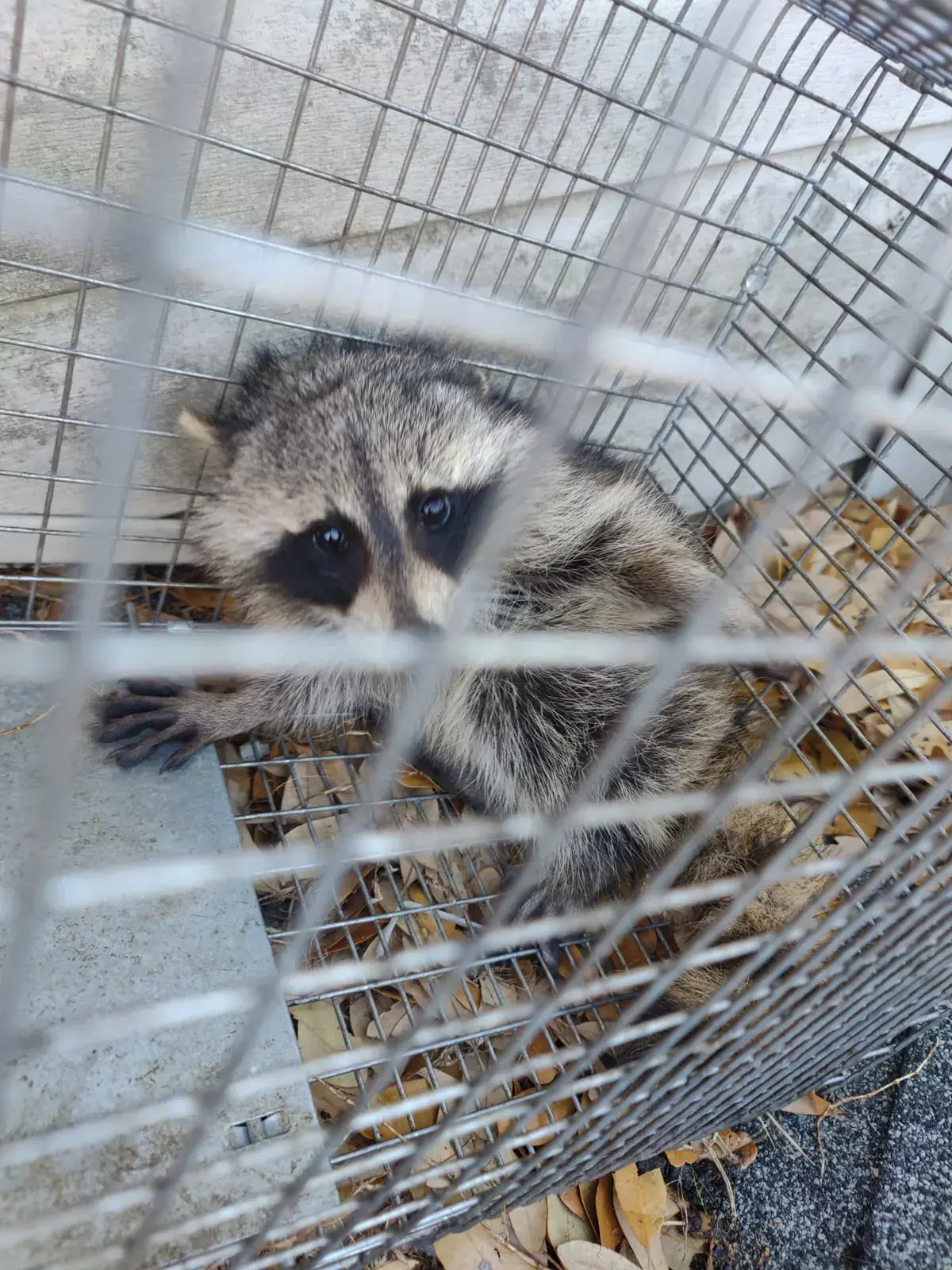 Raccoons
October 26, 2026
Found a Baby Raccoon in Florida? What to Do, and Why You Can't Keep It
A baby raccoon on its own usually isn't an orphan. Here's what FWC says to do, when to call a wildlife rehabilitator, why Florida law won't let you raise it, and what to do if the family is in your attic.
Read more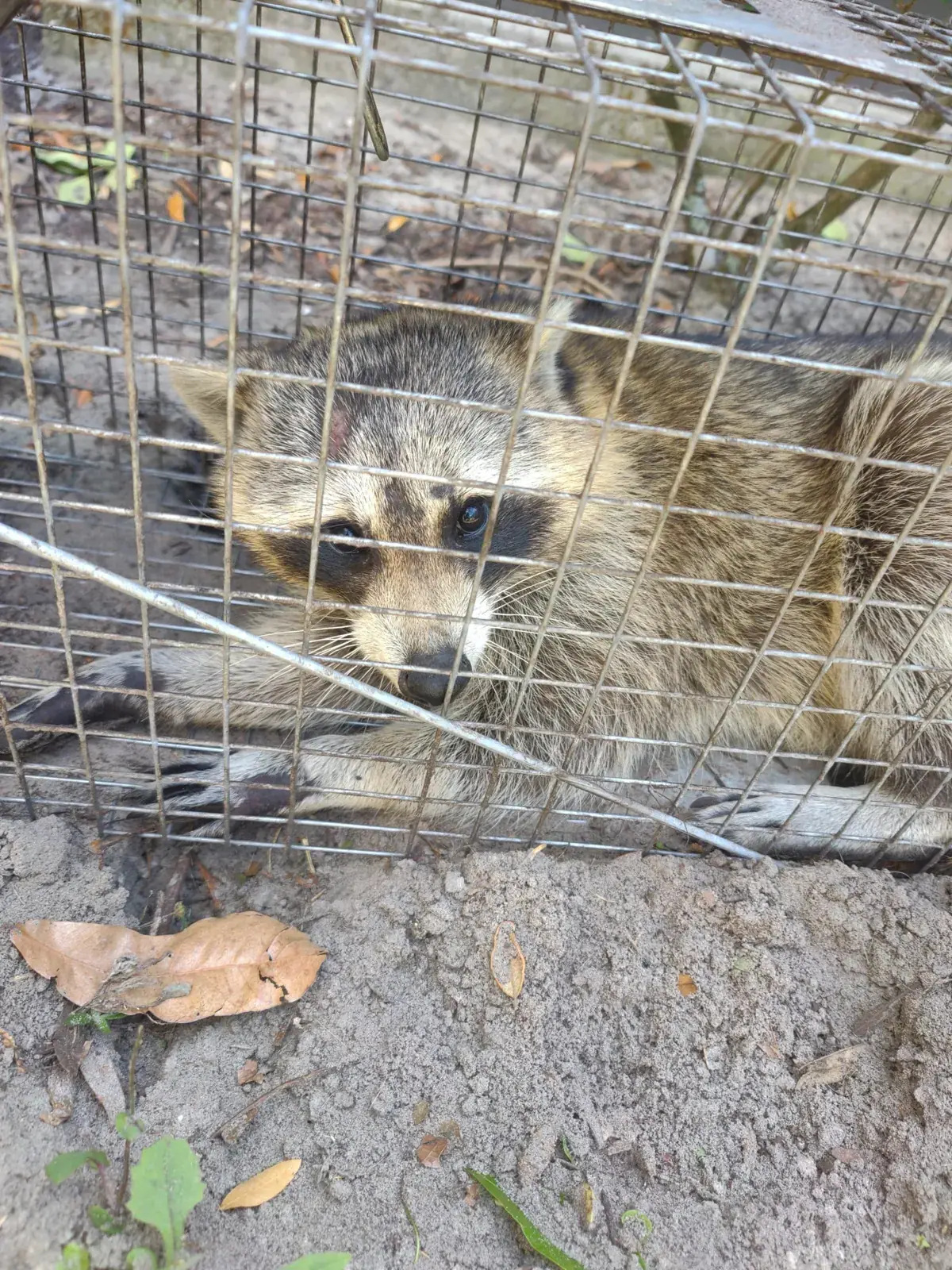 Raccoons
October 21, 2026
Raccoon Mating Season in Florida
If you have heard chittering or found nesting material in a crawl space recently, raccoon mating season in Florida is likely the reason.
Read moreRaccoon in the attic?
Call (844) 264-6254. We'll check for babies before anything else.
Serving Central Florida: Pasco, Pinellas, Hillsborough, Hernando, Citrus, Sumter, Polk and Marion counties.